
How Does a Foil Stamping Machine Achieve 0.01mm Pressure Precision Across Thousands of Sheets?
You have run a thousand sheets of luxury cosmetic boxes. The first one looked perfect – crisp foil, sharp edges, even embossing. But by sheet number 500, the pressure drifted. The foil started to smudge on fine text. By sheet 800, the embossing depth was uneven. That is the reality of mechanical stamping presses without closed‑loop control. A modern foil stamping machine, however, holds 0.01mm pressure precision from the first sheet to the last. How does it do that? This guide breaks down the key technologies that maintain that level of accuracy over long runs: digital pressure control, rigid frame construction, and adjustable gripper systems.
Why Pressure Precision Matters More Than You Think
Foil stamping is not just about applying a shiny layer. The pressure determines everything: whether fine text reads clearly, whether embossing has consistent depth, and whether the foil tears at the edges.
What happens when pressure varies
Too little pressure, and the foil does not transfer fully – you get spots or missing areas. Too much pressure, and the foil crushes, paper fibers compress, and the stamp looks smudged. A variation of just 0.05mm can ruin a high‑end packaging job. For micro‑text (such as 4pt fonts found on pharmaceutical packaging or security labels), the tolerance is even tighter.
The challenge of long runs
As the machine runs, heat builds up. The press bed expands. The cutting plate wears. Mechanical linkages loosen. Without active compensation, pressure drifts. A foil stamping machine designed for sustained accuracy must counter these physical changes in real time.
How traditional presses fail
Older stamping presses rely on mechanical stops and manual pressure adjustments. Operators check the first few sheets, then assume the setting holds. But as the machine warms up, the frame expands, increasing the gap between the platens. Pressure drops. By mid‑run, the foil transfer becomes inconsistent. The only fix is to stop the machine, re‑adjust, and waste more sheets for testing.
Three Technologies That Lock in 0.01mm Precision
Based on real equipment specifications, here is how industrial‑grade finishing machines maintain pressure accuracy across thousands of impressions.
Digital closed‑loop pressure control
Instead of mechanical screws and manual adjustments, a servo‑driven system continuously monitors the pressure at the stamping plate. Sensors feed data back to the controller, which makes micro‑adjustments every cycle. The result: pressure stays within ±0.01mm of the setpoint. This closed‑loop design also compensates for thermal expansion and tooling wear automatically.
Rigid high‑mass frame construction
A flimsy frame flexes under load, changing the gap between the upper and lower platens. Heavy cast‑iron frames with cross‑bracing absorb stamping forces without bending. Industrial foil stamping machines weigh several tons – the mass provides mechanical stability that lightweight presses cannot match. After casting, the frame is stress‑relieved to prevent warping over time.
Adjustable grippers that maintain sheet position
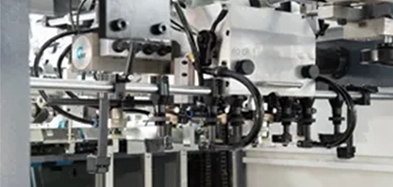
If the sheet shifts even 0.1mm, the stamp lands off‑register. Adjustable grippers hold the paper firmly throughout the feed, stamping, and delivery stages. Because they are adjustable, operators can fine‑tune them for different paper thicknesses without losing alignment. The grippers are designed to leave minimal marks on the printed side – critical for high‑value packaging.
Beyond Pressure – Other Factors That Affect Stamp Consistency
Pressure alone does not guarantee perfect foil transfer. Several other subsystems play critical roles.
Synchronous longitudinal and transverse foil feeding
If the foil feed is inconsistent, the foil may wrinkle or break. Synchronous longitudinal and transverse feeding pulls foil smoothly from the roll and aligns it precisely with the stamping die. The system also monitors remaining foil length and stops automatically when the roll is low – preventing partial stamps. This dual‑direction feeding also reduces foil waste because you can stamp multiple images from the same foil strip without large gaps.
Up to six independently controlled foil axles
Each axle is driven by a Japan Yaskawa servomotor. Independent control allows complex jobs with multiple foil colors or positions on the same sheet – each with its own pull length and tension. The system automatically calculates the required foil length and simulates the layout on the HMI screen. For jobs with holographic foil, diffraction patterns, or multiple spot colors, this capability is essential.
Temperature uniformity across the heating plate
Foil transfer requires heat. If the heating plate has cold spots, the foil will not stick evenly. Multi‑zone PID controllers maintain the same temperature across the entire plate. The heating elements are cast directly into the plate, eliminating hotspots. Operators can set different temperatures for different zones if the job requires it.
Non‑stop feeding with preload
Pressure precision means nothing if the machine stops every hour to reload paper. A preload device holds a second pile of paper (up to 1600 mm high) and switches automatically when the active pile runs out. The stamping head never pauses. For a full shift, this can add hours of productive running time. The preload carriage is rail‑guided, allowing operators to position the next pile accurately and safely.
A foil stamping machine that combines digital pressure control, rigid construction, synchronous foil feeding, and non‑stop feeding can run tens of thousands of sheets with consistent quality.
How Fast Can You Change Over Between Jobs?
Job changeover is often the hidden productivity killer. A machine that takes hours to switch from one foil type to another kills your ability to run short runs profitably.
Recipe storage and recal
The 19‑inch HMI touch screen stores job parameters – pressure, temperature, foil pull length, die position, and registration settings. Switching from a wine label to a cosmetic box takes minutes: recall the recipe, load the new foil and die, and run a few test sheets. No manual adjustments with wrenches. The system can store hundreds of recipes.
Quick‑change foil mandrels
Foil rolls are heavy and awkward to handle. The machine uses retractable, operator‑friendly foil holders that allow one person to load a new roll quickly. For larger rolls (up to 320mm diameter on request), the holders are designed with ergonomic handles and safety locks.
Die exchange system
The die‑cutting unit uses a standardized chase and plate system. Pre‑mounted dies can be swapped in minutes. Alignment pins and magnetic clamping reduce setup time. For jobs that require both stamping and die‑cutting in the same pass, the dual‑unit design eliminates the need to move sheets between machines.
First‑sheet verification
After a changeover, the machine can run a single sheet at low speed for inspection. The operator checks register and pressure on the touch screen, makes fine adjustments, then resumes full production. This reduces wasted sheets compared to traditional trial‑and‑error methods.
Maintenance and Long‑Term Reliability
Precision machinery needs regular care to maintain 0.01mm accuracy over years.
Daily operator checks
Operators should inspect the heating plate for foil residue, clean the grippers with a soft brush, and check the foil path rollers for debris. The HMI includes a maintenance reminder checklist. These tasks take less than ten minutes per shift.
Monthly calibration
Pressure sensors and thermocouples drift slowly over time. A built‑in calibration routine uses reference sensors to verify and adjust readings. The process is guided by the touch screen and takes about 15 minutes.
Wear parts replacement schedule
The cutting plate, stripper pins, and suction cup rubbers wear after millions of cycles. GUOWANG provides a recommended replacement schedule based on cycle count. Spare parts are stocked and can be shipped quickly. Many users report that with proper care, the machine runs for over a decade before major component replacement is needed.
Cleaning and lubrication
Key moving points – such as the gripper bar linkages and the foil feed mechanism – require periodic lubrication. The manual specifies food‑grade grease for applications in food packaging environments. A central lubrication system is available as an option.
Real‑World Applications: Where 0.01mm Precision Shows Up
The difference between 0.01mm precision and looser tolerances is visible in finished products.

Luxury cosmetic boxes
Gold foil stamping on a black carton requires crisp edges. Any pressure variation causes smudging or incomplete transfer. With 0.01mm control, fine logos and small text remain sharp across the entire run.
Wine and spirit labels
Holographic foil and micro‑text are common on premium labels. Registration between multiple foil colors must be perfect. The independent foil axles and closed‑loop pressure system deliver that precision.
Greeting cards and invitations
Intricate die‑cut shapes combined with foil stamping demand both accurate cutting and consistent foil transfer. The integrated waste removal unit strips away the matrix without damaging the delicate card stock.
Pharmaceutical packaging
Security features such as tamper‑evident seals and micro‑printing require extreme accuracy. Reject rates must be near zero. A reliable foil stamping machine with 0.01mm precision helps achieve that.
A Machine That Puts All This Together – From a Builder with Decades of Experience
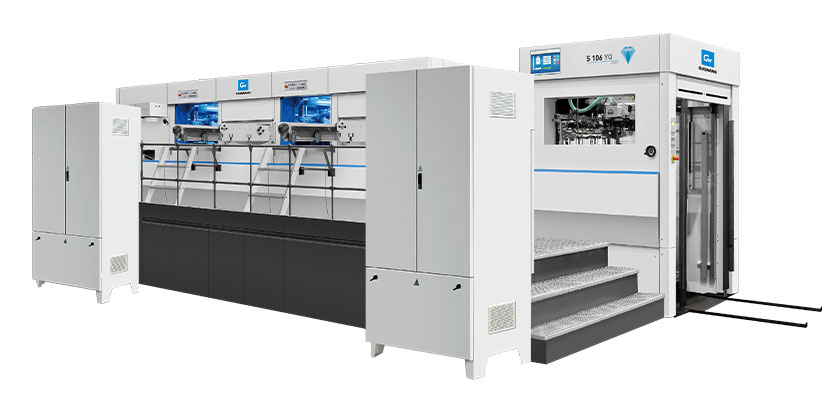
All the features described above – 0.01mm digital pressure control, synchronous foil feeding, up to six independent foil axles with Yaskawa servomotors, multi‑zone temperature regulation, non‑stop feeding with 1600mm pile height and preload, 4+4 suction cups, recipe storage, quick changeover, and integrated waste removal – are built into the S106YQ Double‑Unit Automatic Hot Stamping & Waste Removal Die‑Cutting Machine.
The machine comes from GUOWANG, a post‑press equipment manufacturer founded in 1993. With over 400 employees, 160,000 m² of factory space, and more than 100 patents, GUOWANG has invested over 30 million RMB in advanced production lines. Their equipment carries CE certification and is exported worldwide. The company practices 7S management, guided by experts from Siemens.
Key specifications of the machine
| Specification | Detail |
|---|---|
| Units | Two independent – hot stamping + die‑cutting with waste removal |
| Foil axles | Up to 6, each with Japan Yaskawa servomotor |
| Pressure adjustment | 0.01mm via touch screen |
| Foil feeding | Synchronous longitudinal and transverse |
| Feeding system | 4 lifting + 4 transfer suction cups, preload device, 1600 mm pile height |
| Delivery | Non‑stop with photoelectric protection |
| Controls | 19″ HMI touch screen (stamping), 10.4″ touch screen (delivery) |
| Certifications | CE, ISO 9001 |
For a foil stamping machine (fourth mention) that holds 0.01mm precision across thousands of sheets, the machine delivers on all fronts.
What About Different Substrates?
A versatile finishing line handles various materials without compromising precision.
Paperboard (300‑600 gsm)
Higher pressure and temperature required. The rigid frame handles the load without flex. The grippers need adjustment for thicker stock – the adjustable system makes this easy.
Label stock (80‑120 gsm)
Low pressure, moderate heat. The main challenge is registration, as thin sheets can slip. The suction feed and front lays prevent this. The preload device ensures continuous feeding even with lightweight materials.
Metallic and plastic films
For metallic paper or plastic films, foil transfer can be tricky due to heat sensitivity. The machine’s wide temperature range and precise pressure control allow fine‑tuning. The operator can store separate recipes for each material.
Corrugated board
For short‑run corrugated packaging, the machine can handle moderate thickness with die‑cutting only (without foil stamping). The waste removal unit strips away the matrix cleanly.
Real‑World Example: A 10,000‑Sheet Run of Wine Labels
A European label converter ran a job of 10,000 foil‑stamped wine labels. The design included fine text and a holographic stripe. Using a GUOWANG foil stamping machine, the operator set pressure to the required value via the touch screen. Throughout the run, the closed‑loop control maintained consistent pressure. The reject rate was significantly lower than on their older mechanical press, and the job finished earlier, saving labor and material.
(Note: Specific reject rate percentages and cost savings are not provided here – only the operational outcome.)
Your Next Step – See 0.01mm Precision in Action
You do not have to take specifications on faith. GUOWANG can arrange a live demo or send a video of the S106YQ running your actual substrates. Watch the pressure reading on the HMI as the machine cycles. See the foil transfer quality at start and after an hour of running. Ask about configuration options: up to six foil axles, larger reel diameters (320mm on request), or custom pressure settings for unique embossing depths.
A foil stamping machine that holds 0.01mm precision changes your finishing floor from constant adjustments to predictable, high‑quality output.


 English
 Français
 Español
 Português
 عربي
عربي