
Guide to Stamping Metallic and Holographic Foils on Paper Labels
You‘re looking at a roll of self-adhesive labels. They’re good—clean printing, accurate die-cutting, consistent adhesive. But they‘re not great. They don’t catch the light. They don‘t signal premium quality. They don’t stop a shopper‘s hand.
Now imagine those same labels with a metallic gold or holographic foil stamp. The difference is immediate. A Foil Stamping Machine turns an ordinary label into a brand statement. From holographic anti-counterfeiting to mirror-finish hot stamping, modern foil stamping equipment delivers micron-level precision that transforms packaging into a premium experience.
This guide covers everything you need to know: label stock considerations, foil selection, die engraving for fine details, temperature and pressure settings, and production efficiency tips. For label converters and brand owners, this is a practical playbook for achieving crisp, eye-catching foil stamping on every run.
Label Stock That Works
The substrate you’re stamping on matters as much as the foil itself. Not all label stocks behave the same way under heat and pressure.
Paper vs. Film Labels
Paper labels are generally easier for hot stamping. The porous surface accepts heat and pressure more predictably than film. Film labels—especially polyester or polypropylene—can be stamped, but they require more precise temperature control to avoid melting or distorting the substrate. If you’re new to label foil stamping, start with paper and work your way up to film.
Surface Coating Sensitivity
The coating on the label paper affects heat transfer. Matte coatings often require higher temperatures to achieve the same adhesion as gloss or varnished surfaces. The coating acts as a thermal barrier—you need to push more heat through it to get the foil to transfer properly. Test a small run before committing to a full production batch.
Adhesive Layer Considerations
Heat from the stamping process can activate the adhesive prematurely. If the adhesive gets too hot, it can bleed out the sides of the label or cause the label to stick to the backing liner prematurely. Keep your temperature settings as low as possible while still achieving full foil transfer. Guowang‘s foil stamping machines feature stable temperature control and a PLC touchscreen smart algorithm that cuts foil waste by 15%—precision that matters when you’re working with heat-sensitive label stocks.
Choosing the Right Foil
The foil you choose determines the final effect. Different foils are designed for different applications and visual outcomes.
Metallic Gold and Silver
These are the workhorses of label foil stamping. Gold and silver foils are the most popular choices for branding—they signal premium quality and work across virtually every label application. Gold works particularly well on dark backgrounds; silver pops on lighter stocks.
Holographic Foils
Holographic foils create a rainbow effect that shifts as the label moves. They’re used for two main purposes: anti-counterfeiting (the holographic pattern is difficult to replicate) and eye-catching visual impact (they stop shoppers in their tracks). Guowang‘s machines support high-end anti-counterfeiting processes such as holographic registered stamping, micro-text hot stamping, and variable data stamping. With automatic tracking via photoelectric sensors, they achieve a registration accuracy of ±0.1 mm.
Pigment Foils
Pigment foils are solid colors—white, opaque metallic effects, or custom brand colors. They’re used when you need a metallic effect that matches a specific brand palette. Pigment foils tend to be less reflective than metallic foils but offer more color flexibility.
Foil Width and Reel Size
Match your foil width to your label layout to minimize waste. A foil that’s too wide wastes material; one that’s too narrow forces you to run multiple passes. Guowang’s PLC touchscreen smart algorithm cuts foil waste by 15%—a significant saving over a full production year.
Engraving for Fine Details
Labels are small, and the details matter. The die engraving determines whether your fine lines, reverse text, and intricate patterns stamp cleanly.
Minimum Line Thickness
For brass dies, 0.2mm is the typical minimum line thickness for reliable stamping. Anything thinner risks breaking or not transferring fully. If your label design includes very fine lines, consider photopolymer dies as an alternative.
Reverse Text Requires Deeper Engraving
Reverse text—white or unprinted text surrounded by foil—requires deeper engraving, typically 0.3-0.4mm. The deeper engraving ensures the foil doesn’t bridge across the text area, leaving clean, readable letters. Shallow engraving on reverse text results in foil bridging and illegible type.
Photopolymer Dies for Short Runs
Photopolymer dies are a good option for short runs and delicate fonts. They’re lighter than brass dies, less expensive, and can produce fine detail that brass dies struggle with. The trade-off is shorter service life—photopolymer dies wear out faster, especially on longer runs.
Temperature and Pressure That Fit
Label stock is thinner than paperboard, and it demands different temperature and pressure settings.
Lower Temperature Than Paperboard
Paperboard can take higher temperatures without distorting. Label paper is thinner and more sensitive. Start with lower temperatures—typically 90-105°C—and work up until you achieve full transfer. Guowang’s foil stamping machines combine high precision with heavy pressure, with ±0.15 mm accuracy and 500-ton pressure.
Shorter Dwell Time
High speed is critical for label economics. Label production is about volume, and dwell time—the time the heated die is in contact with the label—needs to be as short as possible while still achieving good transfer. Typical dwell time for labels is 0.2-0.3 seconds. Guowang’s machines deliver output up to 7,500 sheets/hour, handling large-volume orders with ease.
Starting Point Settings
A good starting point for paper labels: 90-105°C temperature, low pressure, and 0.2-0.3 seconds dwell. Run a test, inspect the results, and adjust. If the foil isn’t transferring fully, increase temperature slightly before increasing pressure. Too much pressure can crush the label or cause the adhesive to bleed.
Running Labels Efficiently
Label production is about speed and yield. Here’s how to get both.
Multiple-Up Stamping
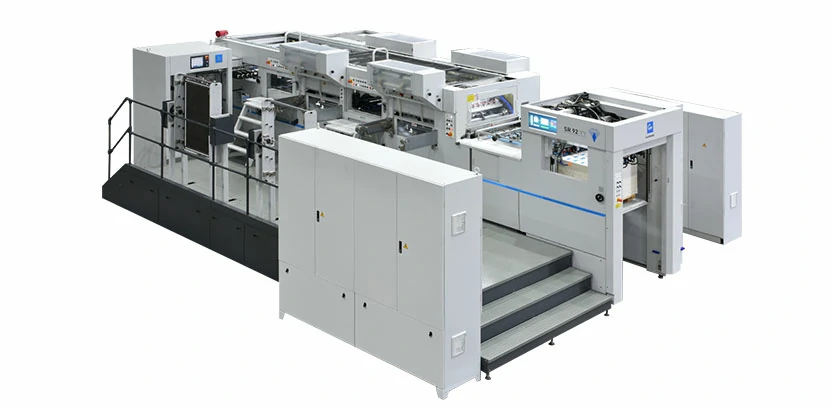
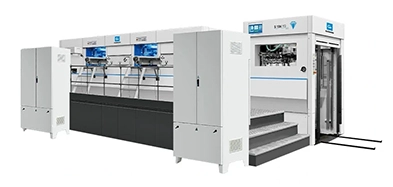
Stamp many labels in one cycle. If your label layout allows it, use multiple-up stamping—a single die that stamps several labels at once. This multiplies your output without increasing machine time. The Double-Unit Hot Stamping Die Cutting Machine is specifically designed for this kind of efficiency.
Web vs. Sheet Feeding
Sheet feeding is more common for label converters who already run sheet-fed presses. Web feeding—running from a roll—is faster but requires different handling and waste removal. Guowang’s machines are available in sheet-fed configurations, with sheet sizes up to 1060×760mm and speeds up to 7,500 sheets/hour.
Handling Small Label Waste
Labels generate small waste pieces—the matrix around the label, the gaps between labels. Use waste matrix removal systems to strip these away cleanly. Waste that isn’t removed can accumulate on the die or cause marking on subsequent labels. Guowang‘s machines support complex processes such as holographic registered stamping and micro-text hot stamping, handling intricate label layouts with precision.
Questions Label Converters Ask
Can I stamp on already die-cut labels?
Yes, but it’s more difficult. Stamping on already die-cut labels requires precise registration—the die needs to hit exactly on the label, not the gap between labels. It’s generally more efficient to stamp first and die-cut afterward. Guowang‘s machines achieve a registration accuracy of ±0.1 mm, meeting the rigorous requirements of the luxury goods and security printing sectors.
How do you prevent foil from bridging across label gaps?
Foil bridging happens when the foil transfers across the gaps between labels instead of only on the label surface. The solution is proper die depth and pressure control. If the die is too shallow or the pressure too high, the foil bridges. Adjust the die depth or reduce pressure slightly. Reverse text requires deeper engraving (0.3-0.4mm) to prevent bridging.
What causes the holographic pattern to look blurry on small text?
Blurry holographic patterns on small text are usually caused by insufficient die depth or incorrect temperature. Holographic foils are thicker and require more heat to transfer fully. Increase temperature gradually (5°C at a time) until the pattern is crisp. If that doesn’t work, check the die depth—holographic foils need deeper engraving than standard metallic foils. Guowang‘s machines feature automatic photoelectric tracking and registration accuracy of ±0.1 mm, ensuring crisp results even on intricate holographic patterns.
Maximizing Visual Impact
Foil stamping on labels isn’t just about adding shine—it’s about creating a visual impact that drives purchase decisions.
Contrast Is Everything
Metallic and holographic foils work best when they contrast with the label background. A gold foil on a dark navy or black background creates a dramatic effect. Silver on white is subtle; silver on deep red is striking. Guowang‘s machines support mirror-finish embossing and deep embossing/debossing in a single operation, delivering rich, crisp stamping results.
Small Details, Big Impression
On a label, even small foil details make a big impression. A tiny holographic logo in the corner signals authenticity. A narrow metallic border frames the brand name. Fine-line foil stamping on a label says “this product is premium” without a single word. With ±0.15 mm accuracy, Guowang‘s machines handle the fine details that elevate a label from good to exceptional.
Consistency Across the Run
The best-looking first label doesn’t matter if the thousandth label looks different. Consistency is what separates professional label converters from the rest. Guowang‘s machines are built with 100 in-house CNC machining centers and Hexagon coordinate measuring machines, ensuring that every component achieves micron-level precision and long-term machine stability.
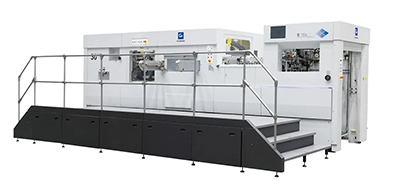
Guowang Group manufactures foil stamping machines designed for packaging and printing companies seeking the ultimate in hot stamping results and consistent production capacity. The Double-Unit Hot Stamping Die Cutting Machine is one of their key models, supporting sheet sizes up to 920×650mm with a maximum die-cutting speed of 7,000 sheets/hour. With ±0.15 mm accuracy, stable temperature control, and a PLC touchscreen smart algorithm that cuts foil waste by 15%, it’s built for the demands of high-volume label production.
Guowang‘s manufacturing capability includes 100 high-precision CNC machines and Hexagon coordinate measuring equipment, with 100% of core components manufactured in-house. The company offers comprehensive after-sales service, including technical support, spare parts supply, and operator training. A global spare parts inventory ensures quick delivery of common components, minimizing downtime.
Metallic and holographic foil stamping on paper labels is one of the most effective ways to elevate a brand’s packaging. The combination of premium materials, precise machinery, and careful process control transforms an ordinary label into a powerful marketing tool. With the right label stock, the right foil, the right die engraving, and the right machine settings, you can achieve crisp, eye-catching results that stop shoppers and sell products.
Ready to elevate your label production with metallic or holographic foil stamping? Reach out to Guowang Group’s technical team—they can provide die engraving guidance, foil recommendations, and machine specifications to help you achieve the perfect stamp on every label.


 English
 Français
 Español
 Português
 عربي
عربي