
Why would a foil stamping machine need two stamping units in one pass?
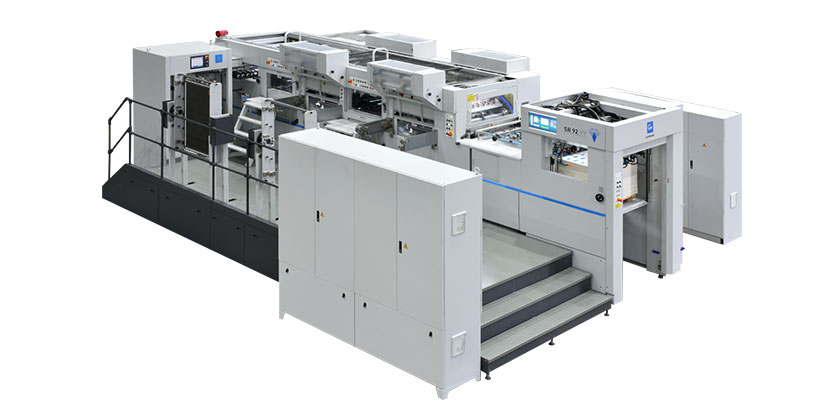
A foil stamping machine configured with two independent stamping/die‑cutting units changes that arithmetic. The sheet feeds once, passes under the first unit (hot foil stamping), then travels to the second unit (additional stamping, hologram application, or die‑cutting), and exits as a finished product. Two processes, one pass. This guide examines the double‑unit series from Guowang, comparing the SR920YY (medium‑format, high‑speed) and S106DYQ (large‑format, heavy‑duty) models: sheet size, speed, pressure, heating zones, registration accuracy, and the practical trade‑offs that determine which dual‑station configuration fits your job mix.
Two workstations: what double‑unit architecture actually does on the floor
A dual‑station flat‑bed configuration isolates the two main finishing processes into separate physical units along the same paper path. The first unit handles hot foil stamping, hologram stamping, or embossing. The second unit handles die‑cutting, stripping, blanking, or a second stamping application.
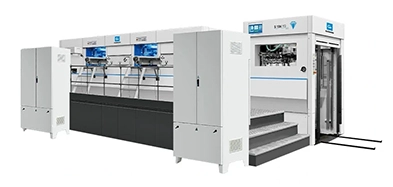
On the S106DYQ, the dual‑platform design delivers what the manufacturer calls "double efficiency improvement"—two imprinting stations complete their work during a single machine cycle, greatly reducing the number of passes required for complex jobs [8†L7-L9]. Jobs that previously required two or three separate runs are completed in one pass, cutting operator intervention and misregistration risk.
Why two units instead of running the sheet twice through a single‑unit machine
A single‑unit press doing two stamping passes forces the operator to reload the entire stack, reset the foil feed, and re‑register the sheet a second time. Register error between passes typically runs 0.2‑0.3mm even with careful setup.
A dual‑unit machine keeps the sheet registered to the same gripper edge across both stations, eliminating the reload step and the registration drift that comes with it. The integrated transmission connecting rod structure on S106DYQ guarantees the consistency and coordination of the dual‑platform movements, with double coding detection ensuring safety and reliability [9†L9-L12].
How dual stations reduce work‑in‑progress inventory
With a single‑unit press, sheets sit in stacks between passes, taking up floor space and risking damage. A double‑unit machine outputs finished sheets in one continuous stream, shrinking work‑in‑progress by two‑thirds on complex jobs.
SR920YY vs S106DYQ: what the spec sheets actually say
| Parameter | SR920YY | S106DYQ |
|---|---|---|
| Max sheet size (mm) | 920×650 | 1060×760 |
| Min sheet size (mm) | 360×320 | 360×360 |
| Max die‑cutting size (mm) | 910×630 | 1045×745 |
| Max die‑cutting speed (sheets/h) | 7000 | 5500 |
| Max stamping speed (sheets/h) | — | 5000 |
| Max die‑cutting force (tons) | — | 550 / 320 |
| Heating zones | — | 20 independently controlled |
| Paper thickness | 90‑2000 g/m² | 90‑2000 g/m², corrugated ≤4mm |
| Registration precision | — | ±0.075mm |
| Total power (kW) | — | 56 |
| Weight (tons) | — | 42 |
*Data sourced from GUOWANG product pages [8†L28-L36][9†L29-L37][1†L6-L13]*
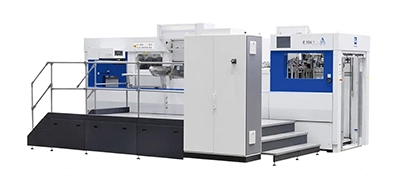
The SR920YY is built for speed: 7000 sheets per hour die‑cutting. The S106DYQ trades peak speed (5500 sheets/hour) for larger sheet capacity (1060×760mm) and heavier construction. For converters running maximum sheet‑size candle boxes or wide‑format luxury packaging, the 1060mm length on S106DYQ matters. For those doing high‑volume cigarette cartons, the SR920YY may be the better fit.
20 independent heating zones: why temperature uniformity determines whether foil sticks or flakes
The S106DYQ uses 20 independently controlled temperature zones across the stamping area, with a range of 30‑200°C [8†L33-L34]. For a 1060×760mm sheet with a full‑coverage foil design spanning the entire width, the centre of the platen naturally runs hotter than the corners. With independent control, centre zones can be set cooler while corner zones run warmer, equalising the actual temperature at the paper surface.
How zone control saves foil on partial‑coverage jobs
If your design only stamps in the left half of the sheet, you can turn off the right‑side heating zones entirely. That reduces energy consumption and prevents the paper from drying out on un‑stamped areas.
What temperature drift does to hologram registration
Holographic foils are temperature‑sensitive. A 5°C drift across the platen shifts the diffraction pattern, making holograms appear misaligned even when the sheet position is perfect. The S106DYQ’s ±1°C zone‑to‑zone accuracy keeps holograms stable across the entire run.
Pressure and material range: 550 tons changes what you can run
The S106DYQ delivers 550 tons of die‑cutting force as a maximum, with a 320‑ton rating for standard operation [8†L30-L31]. That is enough to kiss‑cut thick folding carton board (90‑2000 g/m²) and corrugated board up to 4mm thick [8†L30-L31].
Why 0.01mm pressure adjustment matters for kiss‑cutting labels
The die‑cutting force adjustment is micro‑adjustable in 0.01mm increments, accessible through the touch screen and driven by a worm gear connected to a servo motor [1†L31-L34]. For self‑adhesive labels, cutting through the liner means scrapping the entire sheet. The 0.01mm resolution lets you dial in the perfect depth.
What happens when pressure is too high on thick board
Excessive pressure crushes the board’s edges, creating fuzzy cut lines that cause gluing problems downstream. The S106DYQ’s pressure sensor array detects local overpressure and alerts the operator before the die damages the material.
Register precision: ±0.075mm vs ±0.20mm – how to interpret the numbers
The S106DYQ specification lists two precision numbers: ±0.075mm for die‑cutting/hot stamping and ±0.20mm for hologram stamping [8†L33-L34].
What ±0.075mm enables in folding carton production
At 0.075mm tolerance, a folding carton’s glue tabs align perfectly with the body panel, eliminating the “stepped” edges that make automatic gluing machines jam. Pharmaceutical carton printers require this precision to pass vision inspection systems.
Why holograms accept a wider ±0.20mm spec
Hologram registration depends not only on sheet position but also on foil feed timing and diffraction pattern alignment. Achieving ±0.075mm would require active foil tension correction at every cycle—possible but adds cost and maintenance. The 0.20mm spec is commercially acceptable for most security and decorative hologram applications.
Foil feeding: simultaneous longitudinal and transversal stamping
Guowang's double‑unit machines support synchronous longitudinal and transversal foil feeding, enabling stamping in both directions during the same pass [8†L47-L48][9†L48-L49].
How two‑directional feeding cuts foil waste by 15‑20%
Longitudinal‑only feed might leave 20‑30mm gaps between transverse stamping positions. Transversal movement closes those gaps, reducing unused foil. On an expensive holographic foil job, that saving can exceed 20%.
Changing foil rolls without stopping the press
Non‑stop foil feeding uses two shafts per direction. When one roll runs out, the second automatically feeds in, and the empty core is ejected. Operators replace spent rolls while the press continues running at full speed.
Three pre‑delivery checks specific to double‑unit machines
Before signing a purchase order for any dual‑station foil stamping machine, run these additional tests:
Station‑to‑station register consistency
Print registration marks from station 1 onto a sheet. Then from station 2 onto the same sheet. Measure the offset between marks across the entire sheet width. Variation should not exceed the stated tolerance (S106DYQ specifies ±0.075mm) [8†L33-L34]. Repeat at full production speed after a 30‑minute run.
Foil feed synchronisation
Run the machine at rated stamping speed for 20 minutes. Stop without slowing down. Measure the distance from the leading edge of the stamping area to the start of the foil pattern on both stations. If the foil has advanced beyond the register marks by more than 2mm on either station, the foil feed timing needs recalibration.
Double station simultaneous stamping
Design a test job that stamps a pattern from station 1 and a second, overlapping pattern from station 2. Inspect 20 consecutive sheets for interference—overstamping where the second station overlays the first should show clean registration. This test catches any vibration‑induced misalignment between the two stations.
How the double‑unit series fits into Guowang's post‑press portfolio
Guowang has manufactured post‑press finishing equipment for over three decades, with expertise spanning hot foil stamping, die‑cutting, and stripping machinery [6†L36-L39]. Their machines carry ISO 9000 and CE certification (TÜV Germany) [0†L37-L38].
The double‑unit series, including the SR920YY and S106DYQ, complements Guowang's single‑unit models (C80Y, C106DY, C106Y). For converters who already run a single‑unit line for standard jobs, a double‑unit machine handles complex multi‑process work, freeing the single‑unit line for simpler runs.
Field service commitment: Remote support available 24/7, spare parts inventory in major regions, on‑site technician dispatch for major repairs, and calibration checks performed within the first 100 operating hours of a new installation [10†L34-L37].
Matching the machine to your typical job mix (H2)
A foil stamping machine configured as a double‑unit makes the most sense if your work mix regularly requires two finishing processes on the same sheet in the same pass.
Choose the SR920YY if your sheet size stays under 920×650mm, you prioritise speed (7000 sheets/hour) over sheet capacity, and your typical material runs within the 90‑2000 g/m² board range.
Choose the S106DYQ if you need to run 1060×760mm sheets for luxury folding cartons, large‑format print, or corrugated board up to 4mm thick. The 20‑zone heating system and 550‑ton pressure provide capability for heavy embossing and hologram stamping that smaller presses cannot match.
For converters already running separate foil stamping and die‑cutting lines, replacing both with one double‑unit machine typically pays back within 18‑24 months through labour savings alone.


 English
 Français
 Español
 Português
 عربي
عربي