
Why Add Stripping to an Automatic Die Cutting Machine?
An Automatic Die Cutting Machine normally hands off a die-cut sheet with the waste still attached, and a separate stripping station or manual team clears the holes. The R130Q folds that second step into the same machine. You'll see how the inline stripping frame removes waste inside the die-cutting cycle, what the gripper and locking systems contribute to that timing, and how the format envelope reads for a converter.
What Questions Come Up Before Combining Cutting and Stripping?
Why put stripping on the die-cutting machine instead of a separate station?
The page describes the R130Q as completing die-cutting and waste stripping in one go, generating high-quality stacking and counting batches immediately, and significantly reducing workload and related costs. The practical difference is the handoff: a separate stripping station requires the sheet to be transferred, re-registered, and stripped against its own tooling. An inline stripping frame works on the sheet while it's still held by the die-cutting machine's gripper system, so the registration established at the cutting station carries through to the stripping station. That's what allows short-run non-repetitive orders to run without a full setup at a second machine.
Can the same machine run die-cutting only?
Yes—the page lists die-cutting and waste stripping conversion as a feature: one machine for multiple uses, with flexible conversion between die-cutting and waste stripping. That means the stripping frame can be taken out of the process when a job doesn't need it, and the machine runs as a straight die-cutter. For a converter whose job mix includes both simple die-cut work and multi-up jobs that need the holes cleared, that conversion capability lets one platform cover both without dedicating floor space to a separate stripping machine.
The Stripping Frame and the Pull-Type Transmission
The component that defines the R130Q's stripping capability is the waste stripping frame, and the page describes its transmission as a pull-type design that increases the force arm for uniform strong power, reducing impact and vibration to ensure stable high-speed heavy-duty stripping.
That detail matters at 6500 sheets/hour. At that rate, the stripping frame is cycling more than once per second, and any vibration in the frame translates into inconsistent stripping—a scrap that stays in the hole, or a product edge that gets marked by the stripping tool. The pull-type transmission spreads the stripping force across the frame rather than concentrating it at a single push point. The result is a stripping stroke that stays flat across the full 1285×935mm die-cutting area, even on multi-up layouts where the waste pattern is uneven.
The page also describes the stripping structure as an upgraded active upper stripping frame suited to complex multi-up products, with a fixed middle frame and movable rails preventing scrap carry-out. "Scrap carry-out" is the failure mode where a stripped piece travels with the sheet into the delivery pile. On a multi-up job with dozens of small waste pieces per sheet, one carried-out scrap becomes a defect in the finished stack. The fixed middle frame and movable rails are the geometry that keeps each scrap piece moving down into the waste collection rather than riding along with the product.
What the pneumatic lifting device changes about setup
The page lists a pneumatic lifting device for the upper waste stripping frame that automatically lifts and resets the frame instead of manual work, cutting labor intensity and shortening adjustment time. On a machine with a heavy upper stripping frame, moving that frame by hand for each job change is slow and physical. The pneumatic lift turns a manual task into a button press, which is the difference between a changeover measured in minutes and one measured in tens of minutes.
Gripper, Registration, and the Feed Chain
Inline stripping depends on the sheet staying in the same reference position from the cutting station to the stripping station. The page lists aerospace aluminum gripper bars with ±0.05mm flatness, CMM inspected, and imported gripper blades with ±0.25mm length tolerance and a 3-year service life.
Those tolerances are the mechanical foundation of registration. A gripper bar that's not flat will hold the sheet at a slight angle, and that angle compounds across the sheet width. At 1300mm, a small angular error becomes a visible offset at the far edge. The ±0.05mm flatness figure is what keeps the sheet's leading edge parallel to the die line, so the stripping tools can be positioned to the same reference the cutting tools used.
The page also lists a secondary gripper opening that precisely controls gripper rows to clear mouth waste, solving cleaning troubles and upgrading die-cutting efficiency and product quality. The "mouth waste" is the strip of waste at the gripper edge, which is often the hardest to clear because the grippers are holding that edge. A secondary opening lets the gripper release that edge at the right moment in the stripping cycle, so the mouth waste drops out rather than staying attached.
Why the feeder's pre-stacking height matters for non-stop running
The page lists a self-developed 4-suction 4-feed feeder with 1600mm pre-stacking, enabling non-stop operation. Pre-stacking means a new pile can be loaded while the current pile is still feeding. On a machine running 6500 sheets/hour, every stop to reload the feeder is a direct loss of output. The 1600mm pre-stack height is what gives the operator enough time to prepare the next pile without the machine running empty.
The Format and Material Envelope
The R130Q's working envelope is defined by the sheet size range, the material specification, and the die-cutting pressure.
| Parameter | R130Q specification |
|---|---|
| Sheet size (max / min) | 1300×950mm / 550×450mm |
| Max. die-cutting area | 1285×935mm |
| Max. die-cutting pressure | 450t |
| Max. die-cutting speed | 6500 sheets/hour |
| Paperboard | 0.1–3mm |
| Corrugated board | ≤4mm |
| White paperboard | 90–2000 g/m² |
| Gripper margin | 9–17mm |
| Feeder pile height | 1600mm (incl. pallet) |
| Delivery pile height | 1350mm (incl. pallet) |
| Main motor / total power | 15kW / 26kW |
| Weight / dimensions | 30t / 7280×4680×2460mm |
The 450t pressure rating and the 4mm corrugated capability put the machine in the heavy-duty tier. Corrugated board is thicker and more compressible than paperboard, so the die-cutting force has to travel through the flute structure without crushing it. The 450t rating is what lets the same machine cut paperboard at the thin end of the range and corrugated at the thick end without running out of pressure on the heavier stock.
What the gripper margin range tells you about layout
The gripper margin is listed as 9–17mm. That's the strip at the leading edge of the sheet that the gripper bars hold, and it can't carry printed product. A 9mm margin uses less of the sheet but demands tighter gripper control; a 17mm margin is more forgiving but wastes more area on every sheet. For a multi-up layout where the sheet is already tight, the 9mm end of the range is the one that determines how many products fit across the sheet.
Where the R130Q Fits a Converter's Floor
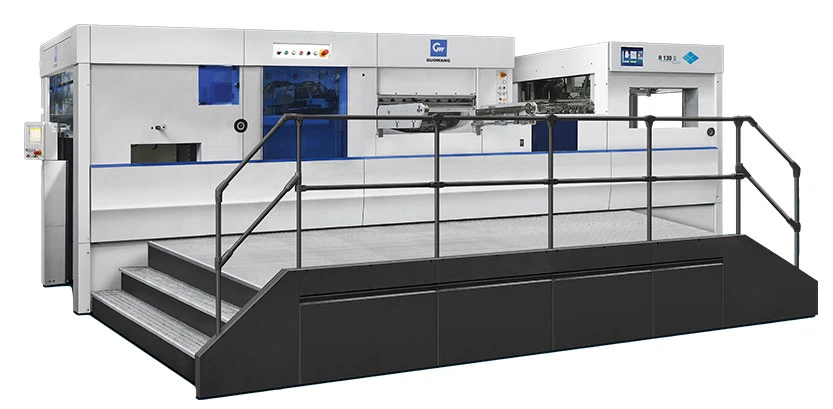
The R130Q Automatic Die Cutting Machine with stripping from GUOWANG is built around the inline stripping architecture the page describes: a pull-type waste stripping frame with pneumatic lifting, aerospace aluminum gripper bars at ±0.05mm flatness, a secondary gripper opening for mouth waste, and a 4-suction 4-feed feeder with 1600mm pre-stacking. The 1300×950mm maximum sheet, 450t die-cutting pressure, and 6500 sheets/hour speed place it in the heavy-duty tier for packaging converters producing cartons, corrugated boxes, and display work. For an Automatic Die Cutting Machine buyer, the value sits in the single-pass flow—the sheet is cut and stripped against the same registration before it reaches the delivery pile, so the stacked batch is finished product rather than a cut sheet waiting for a second operation.
What to confirm before matching a job to the R130Q
Confirm the sheet size against the 1300×950mm to 550×450mm range, the stock against the paperboard and corrugated limits, and the multi-up layout against the 1285×935mm die-cutting area. The 450t pressure and 6500 sheets/hour speed are machine-level ceilings—the actual rate on a given job depends on the die layout, the stock, and whether the stripping frame is in the process. A trial run on the actual stock is the step that confirms the stripping quality and the output rate hold together.
[H2] Let's Check Your Layout Against the Stripping Envelope
Send over your sheet dimensions, stock type, and multi-up layout—we'll help you check them against the R130Q's 1285×935mm die-cutting area, 450t pressure, and inline stripping frame. Talk to GUOWANG about your Automatic Die Cutting Machine requirements and get a format-level answer before you commit to the tooling.


 English
 Français
 Español
 Português
 عربي