
Does an Intelligent Paper Sheeter Need an Operator?
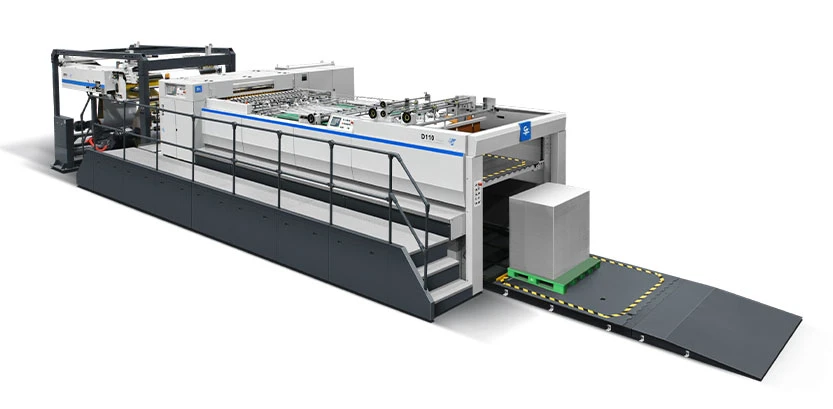
An Intelligent Paper Sheeter still needs an operator to set the cut length, load the parent roll, and monitor the knife condition—but the D-110C's auto-logistics system removes the manual pallet handling that would otherwise stop the line every time a pile fills. The machine cuts 150–1000 gsm board at 570 cuts per minute with ±0.10mm accuracy, and the logistics system keeps empty pallets staged so the cutting station runs through pile changes. This article explains how the double rotary geometry supports that cycle rate, what the auto-logistics system changes about pallet handling, and what to verify when you're matching a high-output sheeter to a paperboard converting line.
What Makes Double Rotary Cutting Faster?
Twin Knives on Separate Cylinders
A single-knife sheeter cuts once per revolution of the knife cylinder. The D-110C uses two knife cylinders rotating in opposite directions, each carrying a cutting blade. Because there are two blades per combined revolution, the machine produces two cuts per cycle instead of one. That geometry is what doubles the cut frequency without doubling the knife speed.
The two cylinders are driven by independent servo motors. The controller synchronizes their rotation with the web speed, so each cut lands at the programmed length. At 570 cuts per minute, the knife cylinders are cycling roughly 4.75 times per second each—fast, but within the range that servo-driven rotary cutters can hold repeatably.
Cut Length Range and Board Weight
The cut length range is 400–1700mm, covering sheet sizes from small carton blanks to large format board. The paper weight range of 150–1000 gsm includes folding carton board, coated board, and heavier rigid stocks.
The ±0.10mm accuracy applies across that range. On a 1000gsm board, a 0.10mm length error is negligible against the sheet dimension. On a thinner 150gsm sheet, the same accuracy keeps the stack aligned and the downstream gripper feeding consistent.
| Parameter | D-110C Specification |
|---|---|
| Paper weight range | 150–1000 gsm |
| Maximum paper format | 1100 mm |
| Maximum roll diameter | 1800 mm |
| Cut-off length range | 400–1700 mm |
| Cutting accuracy | ±0.10 mm |
| Maximum cutting speed | 300 m/min |
| Maximum cutting frequency | 570 p/min |
| Delivery pile height (incl. pallet) | 1700 mm |
| Main motor power | 90 kW |
| Total power | 115 kW |
| Machine weight | 22 t |
| Air supply | 6–8 bar; 50 L/min |
How Does the Auto-Logistics System Keep Pallets Moving?
At 570 cuts per minute, the delivery pile fills quickly. If the operator has to stop the line to remove a full pallet, the cutting speed is wasted during the changeover. The D-110C addresses that with an auto-logistics system that moves full pallets out and empty pallets in without stopping the cutting station. The system stages an empty pallet on a buffer conveyor, transfers the finished pile to the outfeed lane, and positions the next pallet under the delivery stacker. The cutting station continues running through the exchange, so the 300 m/min line speed is sustained across the shift rather than interrupted at every pile change. That continuous flow is what makes the high cut frequency useful in practice. A sheeter that cuts 570 times per minute but stops for three minutes every twenty minutes delivers less real output than a slower machine that runs without stops.
Which Paper Grades and Formats Fit the D-110C?
The 1100 mm maximum paper format sets the upper limit on web width. A 1100 mm parent roll can be sheeted into the standard carton blank widths used in folding carton production, and the 1800 mm maximum roll diameter allows jumbo rolls from the paper mill to run without intermediate rewinding.
The 150–1000 gsm range covers the materials used in packaging and commercial print:
-
Folding carton board — coated and uncoated grades for food, cosmetic, and pharmaceutical cartons
-
Coated board — art board and chromo board for high-quality print reproduction
-
Rigid board — heavier stocks that hold their shape in premium packaging
-
Kraft and liner board — unbleached grades for corrugated and industrial packaging components
The cut length range of 400–1700mm accommodates everything from a small carton blank to a large display sheet. The operator sets the length through the control interface, and the servo knives adjust the cutting cycle to match.
Where Does a High-Speed Sheeter Fit in Packaging Production?
An Intelligent Paper Sheeter in the D-110C class is used in paperboard converting, folding carton plants, and commercial print facilities that receive jumbo rolls and need flat sheets for downstream printing or die-cutting. The sheeter sits between the roll warehouse and the press or die-cutter, converting the parent roll into press-ready sheets.
The 300 m/min line speed and 570 cuts/min frequency match the consumption rate of a high-speed sheet-fed press or a large die-cutting line. A press that consumes several thousand sheets per hour needs a sheeter that can supply those sheets without becoming the bottleneck. The auto-logistics system ensures that the supply continues through pallet changes, so the press stays fed.
The D-110C from Guowang is built for that role, with a 22 t machine weight and a 115 kW total power draw that reflect the structural mass and the drive capacity required to sustain 570 cuts per minute on 1000 gsm board.
What Should You Check Before Selecting a High-Speed Sheeter?
How do I match the cut length to my press requirements?
The range is 400–1700mm. Check your largest and smallest sheet sizes against that window. If your product mix includes a sheet shorter than 400mm, the D-110C may not be the right model—a shorter-length sheeter or a different knife configuration would be required. For most folding carton and commercial print work, the 400–1700mm range covers the full sheet spectrum.
What board weight does the knife system handle?
The 150–1000 gsm range is the working window. Lighter stocks below 150gsm may not have enough body to feed stably at 300 m/min, and heavier stocks above 1000gsm may exceed the knife torque capacity. Confirm your grade against the range, and test the material on the machine before committing to a full production order.
What maintenance does the twin-knife system need?
Inspect both knife cylinders for blade wear and edge chipping. A dull blade on one cylinder produces a cut that differs from the other cylinder, and the sheet length alternates between two values. Check the servo synchronization between the two cylinders—any drift affects the cut length consistency. Verify the auto-logistics conveyor alignment and the pallet staging sensors to prevent pile-handling faults.
Straight Answers on High-Frequency Sheeting
What does 570 cuts/min actually mean for output?
At 570 cuts per minute, the machine produces 34,200 sheets per hour if it runs continuously at that frequency. The actual output depends on the cut length: a longer sheet requires a slower knife cycle to maintain the same line speed, so the cuts-per-minute rate and the meter-per-minute rate trade off against each other.
Can the D-110C run lighter paper at full speed?
The 150 gsm lower limit is the practical boundary for stable web handling at 300 m/min. Below that weight, the web may flutter or track poorly at high speed, and the cut accuracy could degrade. For lightweight papers, a lower line speed may be necessary even though the machine is rated for 300 m/min.
What happens during a pallet change without the auto-logistics system?
Without the auto-logistics system, the cutting station has to stop while the operator removes the full pallet and positions an empty one. That stop interrupts the web, and restarting requires re-threading and re-establishing the cut length registration. The auto-logistics system eliminates that stop by staging the next pallet in advance.
What air supply does the machine require?
The air requirement is 6–8 bar at 50 L/min. That supply drives the pneumatic actuators on the delivery system and the logistics conveyors. Confirm the facility's compressed air capacity against that figure—a pressure drop during a pallet transfer could stall the logistics sequence and interrupt the cutting flow.
Let's Match a Double Rotary Sheeter to Your Line
Share Your Board Weight, Cut Length, and Output Target
An Intelligent Paper Sheeter in the D-110C configuration should match your board grade, cut length range, and sheet consumption rate—not the other way around. The D-110C intelligent double rotary sheeter with auto logistics system from Guowang cuts 150–1000 gsm board at 300 m/min and 570 cuts/min, holds ±0.10mm accuracy across a 400–1700mm cut length range, and uses twin servo-driven knife cylinders with an automatic pallet logistics system to sustain production through pile changes. If you're specifying a sheeter for a folding carton plant or a commercial print facility, send us your board weight, cut length, and output target — we'll help you confirm the right configuration before you order.


 English
 Français
 Español
 Português
 عربي