
How Does a Hot Foil Stamping Machine Combine Two Processes?
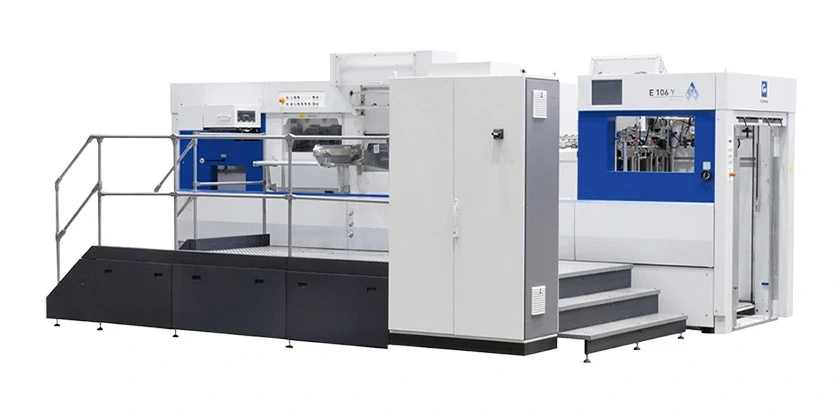
You're producing a premium cosmetic box or a luxury gift carton, and the design needs both a metallic foil logo and a die-cut window. In a traditional workflow, those two operations happen on separate machines — stamping first, then die-cutting, with a stack of foiled sheets waiting in between. A Hot Foil Stamping Machine in the E106Y configuration performs both processes in one platform, applying the foil and cutting the blank in a single production flow. This article explains how the combined architecture works, what the 20-zone heating system contributes to foil consistency, and what to verify when you're specifying an integrated stamping and die-cutting line.
How Does Integrated Stamping and Die-Cutting Work?
Two Functions on One Platen
The E106Y mounts a hot stamping station and a die-cutting station on the same machine frame. The sheet is fed to the stamping platen, where the heated die presses the foil onto the surface. The sheet then advances to the die-cutting station, where the blank is cut to shape. Both operations reference the same sheet registration, so the foil image and the die-cut edge stay aligned.
That shared registration is the core advantage of integration. On separate machines, the sheet is re-registered at the die-cutter, and any deviation between the two setups shows up as a foil image that sits off-center relative to the cut edge. On the E106Y, the stamping and cutting positions are established within one machine coordinate system, so the alignment is built in.
What the Combined Platform Changes in Production
The combined platform removes the intermediate stacking, transport, and re-loading step between stamping and die-cutting. The sheet goes from feeder to finished blank without leaving the machine. For premium packaging, where surface scuffs on the foil are a visible defect, eliminating that handling removes a major source of rejects.
Why Does 20-Zone Heating Matter for Foil Consistency?
The Problem With a Single Heat Source
A large stamping platen — up to 1040×740mm on the E106Y — doesn't heat uniformly. The edges lose heat to the surrounding air faster than the center, and the foil itself draws heat away as it transfers. With a single heating element, the operator has to run the platen hotter overall to keep the edges working, which risks scorching the paper in the center and wastes energy.
Independent Zone Control
The E106Y uses 20 separately controlled temperature zones with ±1°C accuracy. Each zone can be set to a different temperature, so the edges receive more heat and the center receives less. The result is uniform foil transfer across the entire sheet, regardless of where the image sits on the layout.
The zone control also shortens job changeovers. The platen can be preheated evenly before production begins, reducing the waiting time between jobs. And because only the zones that are actively stamping draw full power, the energy consumption drops compared to a uniformly heated platen.
| Parameter | E106Y Specification |
|---|---|
| Max. sheet size | 1060×760mm |
| Min. sheet size | 450×370mm |
| Max. die-cutting width | 1045×745mm |
| Max. hot stamping width | 1040×740mm |
| Max. die-cutting speed | 7,500 sheets/hour |
| Max. stamping pressure | 550 tons (Yaskawa servo) |
| Temperature zones | 20 independent zones, ±1°C |
| Paper range | White cardboard 90–2000g/m²; cardboard 0.1–3mm; corrugated ≤4mm |
| Touch screen | 19-inch for hot stamping station |
| Foil take-up axes | 3 standard, 6 optional |
| Core tolerance | ±0.01mm (Mitsubishi 5-face machining) |
What Does 550 Tons of Pressure Deliver?
The 550-ton maximum stamping pressure is driven by Yaskawa servo control. That pressure level covers the range of premium packaging applications: deep 3D embossing, large-area foil transfers, and thick board stocks that need enough force to deform the surface and bond the foil. The machine handles white cardboard from 90 to 2000g/m², cardboard from 0.1 to 3mm, and corrugated paper up to 4mm. Those material ranges cover cosmetic boxes, cigarette cartons, luxury gift boxes, and electronics packaging — the applications where foil stamping is a primary decorative element rather than an afterthought. The die-cutting width of 1045×745mm and the stamping width of 1040×740mm accommodate the large-format layouts used in these packaging categories.
Where Does an Integrated Platform Fit in Premium Packaging?
Cosmetic Boxes, Cigarette Cartons, and Gift Packaging
The E106Y is built for packaging converters who run foil stamping and die-cutting on the same job. Cosmetic boxes often combine a metallic logo with a die-cut window or a shaped edge. Cigarette cartons use foil for brand differentiation and die-cutting for the pack outline. Luxury gift boxes use deep embossing and foil on the lid, with die-cut inserts or shaped panels.
Running those jobs on one integrated platform simplifies the production schedule. There's no coordination between a stamping department and a die-cutting department, no intermediate inventory, and no risk of the foiled sheets being damaged before they reach the cutter.
Holographic and Anti-Counterfeiting Work
The machine supports holographic image stamping at up to 5,500 sheets/hour , in addition to standard foil stamping at 6,500 sheets/hour and die-cutting at 7,500 sheets/hour. Holographic foils are used for anti-counterfeiting labels and brand protection elements. The 20-zone heating system is particularly relevant for holographic work, because the transfer is sensitive to temperature variation — an uneven platen produces a patchy hologram that fails the visual authentication check.
A Hot Foil Stamping Machine like the E106Y from Guowang integrates the stamping and cutting steps with a 20-zone heating architecture, 550-ton Yaskawa-driven pressure, and a 19-inch touchscreen for the stamping station. The machine's ±0.01mm core tolerance and Mitsubishi 5-face machining reflect the mechanical precision required for premium packaging work.
What Should You Check Before Specifying an Integrated Machine?
How do I match the sheet size to my packaging format?
Compare your maximum and minimum sheet dimensions against the 1060×760mm and 450×370mm range. The stamping width of 1040×740mm and die-cutting width of 1045×745mm define the usable image area within that sheet. If your layout is close to the upper limit, leave margin for gripper and register marks.
What materials can the machine handle?
The machine covers white cardboard from 90 to 2000g/m² , cardboard from 0.1 to 3mm , and corrugated paper up to 4mm. Confirm your specific stock against those ranges, and test the material on the machine before committing to a full production run, because foil adhesion and die-cutting performance vary with coating and fiber composition.
What maintenance does the 20-zone heating system need?
Check the thermocouples and heating elements for drift during periodic maintenance. The ±1°C accuracy depends on the sensors staying calibrated. Clean the platen surface to prevent carbon buildup, which can create hot spots that the zone control can't correct. Verify the foil take-up axes and the break detector function, especially if you run thin or narrow foil.
Can the machine run stamping-only or die-cutting-only jobs?
Yes. The two functions can operate independently. If a job needs only stamping, the die-cutting station can be bypassed; if a job needs only die-cutting, the stamping station can be left idle. That flexibility means the machine covers both combined and single-process production without requiring a separate machine for each.
Straight Answers on Combined Stamping and Die-Cutting
Why does the machine need 20 heating zones instead of fewer?
A large platen develops uneven temperature distribution even with good insulation. The edges run cooler, the center runs hotter, and the foil transfer responds to those differences. Twenty zones provide enough resolution to correct the edge-to-center gradient without overheating any single area. Fewer zones leave larger uncorrected areas, which show up as gloss variation or incomplete transfer on large solid areas.
What causes foil to transfer unevenly across the sheet?
Uneven transfer usually traces back to temperature variation, pressure variation, or foil tension. The 20-zone heating addresses the temperature side. The Yaskawa servo pressure control addresses the pressure side. The foil take-up axes and the break detector address the tension and supply side. If transfer is still uneven after those systems are verified, check the die surface for wear or height variation.
What's the difference between stamping speed and die-cutting speed?
The maximum die-cutting speed is 7,500 sheets/hour. The maximum foil stamping speed is 6,500 sheets/hour , and the maximum holographic stamping speed is 5,500 sheets/hour. The stamping speed is lower than the die-cutting speed because the foil transfer requires a dwell time under heat and pressure, while the die-cutting stroke is a mechanical cut. When running a combined job, the line speed is governed by the slower of the two processes.
What does the core tolerance of ±0.01mm refer to?
The ±0.01mm core tolerance refers to the machining accuracy of the machine's core components, achieved through Mitsubishi 5-face machining. That precision supports the registration stability between the stamping and die-cutting stations. If the core components were machined to a looser tolerance, the sheet would shift slightly between stations, and the foil-to-cut alignment would vary.
Let's Match an Integrated Stamping Line to Your Packaging
Share Your Sheet Size and Process Requirements
A Hot Foil Stamping Machine with integrated die-cutting should match your sheet dimensions, material range, and the balance between stamping and cutting in your job mix. The E106Y Hot‑stamping & Die‑cutting Machine from Guowang handles sheets up to 1060×760mm, applies 550 tons of stamping pressure with 20 independent heat zones at ±1°C accuracy, and runs die-cutting at 7,500 sheets/hour with a 19-inch touchscreen for the stamping station. If you're specifying a combined platform for cosmetic boxes, cigarette cartons, or luxury gift packaging, send us your sheet size and process requirements — we'll help you confirm the right configuration before you order.


 English
 Français
 Español
 Português
 عربي