
What Can Two Units Do That One Alone Can't on an Automatic Die Cutting Machine?
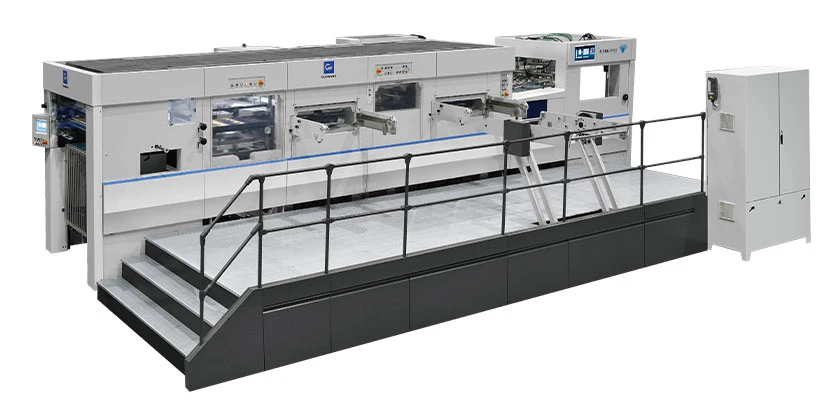
Two die-cutting units sit in one frame and share a drive shaft. An Automatic Die Cutting Machine built this way takes 550t at the first unit, finishes at 320t at the second, and never lets the sheet leave the gripper path. Here's what each stage does.
Three Questions Before the Floor Is Measured
Which Stock Fits Through It?
Sheet from 450×370mm to 1060×760mm, and the stock list is broad: paperboard 0.1-3mm, corrugated board up to 4mm, white paperboard 90-2000 g/m². That covers a folding carton, a corrugated shipper, and a heavy tobacco or alcohol wrap on the same frame — which is why the application set spans color boxes, corrugated boxes, and foil-stamped tags.
How Fast, and How Accurate?
6500 sheets an hour at a die-cutting accuracy of ≤±0.075mm, with a gripper margin of 9-17mm and a chase measuring 1100×770mm inside. The accuracy figure is the one a converter checks first: at that speed, a hundredth of a millimeter drifting per thousand sheets becomes a register problem on the folder-gluer.
What Does the Second Unit Actually Add?
Pressure, first: 550t at unit one, 320t at unit two. Then function: hot stamping with 6 vertical and 6 holographic heads, and waste stripping in line. A single-unit press does one of those jobs and passes the sheet along; this frame finishes all of them before the sheet reaches the delivery pile.
Two Units on One Shaft
Why Sharing a Shaft Matters
The two units are tied by an integrated transmission connecting rod, so their movement comes from one source instead of two controllers trying to agree. Add double coding detection and unit two can't drift out of phase with unit one. Parts are highly interchangeable between the platforms — same families of bearings and gripper components — which trims the spares a plant has to keep in a drawer. A Miki clutch lets one unit run while the other stands by, so a single-unit job doesn't drag the whole frame into production.
Five Castings Under 550 Tons
The Frame That Takes the Load
Five main castings were redesigned by German and Japanese engineers to hold 550t without flexing, and the side plates and worm gears are QT500-7 ductile iron — high tensile strength, thick walls, and a base cast in one piece so the impact has somewhere to go. A concave-convex keyway connection keeps the frame vertical while a die is being adjusted, and a self-locking worm drive with central quantitative lubrication keeps the wear inside the sump rather than on the parts.
Where the Precision Comes From
Two numbers get quoted and they mean different things. ±0.01mm is the machining tolerance on the five faces cut by Mitsubishi, and the pressure adjustment on the touch screen holds to 0.01mm; ≤±0.075mm is the die-cutting accuracy the sheet actually sees. The first is what the factory can build; the second is what an operator can hold at 6500 sheets an hour.
Feeding Without Stopping the Line
Why the Pile Height Is a Production Number
A self-developed four-suction pick-and-four-suction transfer head feeds a wide stock range, and the pre-stacking device carries a 1600mm pile so an operator reloads without a shutdown. Main and auxiliary platforms switch with the line still running. Sheets ride six imported front drive shafts and a German cross steel plate; a precision air valve tunes airflow for thin specialty paper that would otherwise wrinkle or feed crooked, and the belt slows as the sheet nears the front lays so registration settles before the gripper closes.
The Spec Sheet in Full
Where 38 Tons Has to Sit
The rows that matter to a quote are pressure, format, speed, and air: 6-8 bar at 600L/min, a 22kW main motor, 50kW maximum total, and 38 tons of machine on an 8500×5400×2600mm footprint. Check that weight against the floor before anything else — 38 tons doesn't move once it's set, and a delivery pile at 1350mm needs room behind it.
表格
| Item | S106DHQ |
|---|---|
| Paper size | 450×370 mm (min) / 1060×760 mm (max) |
| Paperboard | 0.1-3 mm |
| Corrugated board | ≤4 mm |
| White paperboard | 90-2000 g/m² |
| Max die-cutting format | 1045×745 mm |
| Gripper margin | 9-17 mm |
| Heating zone | Unit 1: 6 zones, 20-120℃ |
| Max die-cutting pressure (unit 1) | 550 t |
| Max die-cutting pressure (unit 2) | 320 t |
| Max die-cutting speed | 6500 sheets/h |
| Die-cutting accuracy | ≤±0.075 mm |
| Feeder pile height (incl. pallet) | 1600 mm |
| Delivery pile height (incl. pallet) | 1350 mm |
| Die-cutting chase, inner | 1100×770 mm |
| Air supply | 6-8 bar, 600 L/min |
| Main motor | 22 kW |
| Max total power | 50 kW |
| Total weight (incl. footboard) | 38 t |
| Overall dimensions | 8500×5400×2600 mm |
Two Pressure Figures, One Frame
The body section quotes 550-600 tons as what the castings can take, while the spec sheet lists 550t at unit one and 320t at unit two. Both hold in their own place: the castings are built to survive more than the working pressure the machine delivers, and the pair of working figures is what a die gets sized around.
What Twenty Heating Zones Buy You
Heat Where the Foil Is, Nowhere Else
The hot stamping system runs a 20-zone energy-saving heater with French sensors and Omron PID control holding ±1℃, plus a preheat function and automatic foil consumption calculation. Fine zoning matters because a full-width heater warms the whole platen and charges you for it every month; zone control lets you switch on only the strip the job needs. Stamping runs 6 vertical and 6 holographic heads at once, and a 19-inch touch screen carries the settings for both.
GUOWANG, the Safety Package, and the Part Count
Safety Monitored in Real Time
GUOWANG builds the S106DHQ Double-Unit Automatic Heavy-Pressing Hot Stamping And Waste-Removing Die-Cutting Machine with a monitoring system that watches the danger zone continuously. What it includes:
- A safety light curtain that stops the frame the moment a hand enters the zone.
- SMC pneumatic upper and lower die locks, so a frame can't be released by hand.
- A torque limiter protecting the gripper bars from a secondary collision.
- Double coding detection on the dual-platform movement.
Certification and the Part Count
The machine is TÜV safety certified and the design carries more than 100 patents — worth less for the plaque than for what it says about how the frame was engineered. The practical upside shows up in the parts: interchangeable components across both platforms, gripper tips from Japan on CMM-inspected hard anodized aviation aluminum bars with ±0.05mm flatness, and standardized stripping tools that also fit machines of other makes.
Send the Stock and the Sheet Size
What to Put in the Enquiry
Send the stock you run, the sheet size range, and the process you need in line — die-cutting alone, die-cutting with foil, or all three including stripping. Those three answers decide the pressure, the unit configuration, and whether the second platform earns its place.
Put them in our request a quotation form and we'll come back with an Automatic Die Cutting Machine configured for your stock, your format, and the processes your jobs actually need.


 English
 Français
 Español
 Português
 عربي