
How Much Die-Cutting Pressure Does the Automatic Die Cutting Machine R106Q Apply to Board?
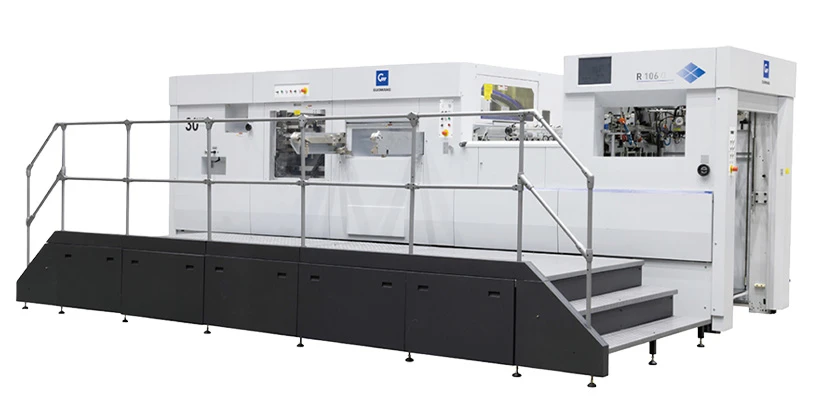
The force that pushes the die through the blank decides whether thick corrugated board and dense cardstock cut cleanly through the full run, rather than nicking the edge or leaving uncut fibers. A flatbed press regulates that force through the main drive, die chase, and pressure-control system, holding a steady tonnage on every sheet while the gripper line carries the stock through the station. Automatic Die Cutting Machine models in the R106Q class deliver a 300t maximum die-cutting pressure, regulated by servo control and backed by pressure-stabilizing and overload protection, with the stock windows, speed, and machine utilities set out below.
What the R106Q Press Covers
What Peak Pressure Does the Die Station Hold Under Full Load?
The R106Q applies a maximum die-cutting pressure of 300t to the board at the cutting station. The servo pressure control system runs precise, computer-controlled pressure regulation with an adjustment accuracy of 0.01mm, and the computer-controlled, high-precision pressure stabilization function keeps operating pressure consistent through the run, which also helps extend cutting-die life. The pressure output is matched to the board gauge and layout rather than run at peak tonnage on every job.
Which Board Gauges Does That Pressure Cover?
The pressure window covers paperboard 0.1-3mm, corrugated board up to 4mm, and white cardstock 90-2000 g/m². That spans light folding carton stock through thicker corrugated blanks, and the layout should be matched to the actual board weight and thickness before the die and stripping frames are set. The press accepts a maximum sheet of 1060×760mm and a minimum of 450×370mm, with a maximum die-cutting area of 1045×745mm and a gripper margin of 9-17mm.
How Does the Press Protect the Die Under Excess Load?
A torque limiter disengages during abnormal conditions to protect the machine from severe damage, and the pneumatic clutch system provides faster braking and more stable operation. Sheet drop detection uses photoelectric sensors to catch sheets falling into the machine interior, preventing damage to the cutting die. The bidirectional quick-lock pneumatic mechanism also guards against improper chase locking that could place uneven load on the die station during production.
How One Pass Combines Die Cutting and Partial Waste Stripping
Cutting and Stripping in a Single Pass
The machine is a multi-purpose single-machine solution that flexibly switches between die cutting and waste stripping. The one-pass die-cutting and waste-stripping flow produces well-stacked, counted batches instantly, which reduces workload and associated costs, and the complete sheet collection suits short-run, non-repetitive orders. The partial waste stripping with double cam opening removes selected scrap areas in-line rather than leaving every piece of skeleton for a separate manual station, while the press still allows change-over between the two functions as the job requires.
Where the Press Sits in Packaging Production
Package Types Cut on the R106Q
The listed applications cover folding color boxes, paper products processing, corrugated cardboard boxes, and tobacco and alcohol packaging. Those markets run folding carton blanks, printed card pieces, corrugated box shapes, and branded packaging tags or boxes, each with its own registration, die layout, and stripping requirement. The press's precision and output quality target the packaging converter producing both retail cartons and industrial board boxes.
Short-Run and Multi-Up Product Layouts
The upgraded active upper stripping frame suits complex multi-up products, where many small shapes share one large sheet. The fixed middle frame and movable rails prevent scrap carry-out during stripping, keeping the run stable on dense layouts. At the other end, the complete sheet collection setup supports short-run non-repetitive orders that do not repeat through long production campaigns.
How the Feeder, Registration, and Gripper Carry the Sheet
Feeder, Belts, and Registration Checks
The self-developed 4-suction 4-feed feeder delivers stable, fast paper feeding across various stocks, with a 1600mm pre-stacking height that enables non-stop operation. Six imported front drive belts, matched with German cross steel plates, keep the paper flat and smooth through transport. Front lay registration uses photoelectric switches to confirm the sheet reaches the lay position, side lay registration triggers a sensor switch through precise mechanical action and works across all print colors, and mechanical double-sheet detection catches over-fed sheets by thickness. A German-made Becker vacuum pump backs the feeder pickup, and aerospace aluminum gripper bars hold ±0.05mm flatness under CMM inspection, with imported gripper blades held to a ±0.25mm length tolerance.
The R106Q Specification at a Glance
What the Parameter Table Lists Up Front
The table groups the model, sheet size, cutting area, stock gauges, margin, pressure, speed, air, power, weight, and footprint exactly as listed, so a buyer can match the press to the plant before an enquiry.
| Item | Detail |
|---|---|
| Model | R106Q |
| Sheet size | Min 450×370mm; Max 1060×760mm |
| Max die-cutting area | 1045×745mm |
| Paper specifications | Paperboard 0.1-3mm; corrugated ≤4mm; white cardstock 90-2000g/m² |
| Gripper margin | 9-17mm |
| Max die-cutting pressure | 300t |
| Max die-cutting speed | 7500s/h (parameter table); 6000 sheets/h (product header) |
| Air supply | 6-8bar; 200L/min |
| Main motor / max total power | 11kW / 20kW |
| Total weight | 18.5T (including footboard) |
| Overall dimensions | 6330×4250×2430mm |
How the Press Locks, Lubricates, and Protects Itself
SMC pneumatic cylinders lock the die frames and bottom plates firmly, preventing improper installation and losses from manual operation errors, and a centerline alignment system provides quick chase positioning without manual offset correction. The pre-stretched chains undergo 72 hours of high-speed simulated operation for precision and stability, and an optimized indexing gearbox extends equipment lifespan while improving gripper bar positioning accuracy. Automatic lubrication covers the main drive in oil-bath and drip form, the chain through programmable intervals and volumes, and the cam the same way; the German Inmunda main motor, pneumatic lower plate lifting, and motorized delivery aids round out the operating and setup systems.
How the Waste Stripping Frames Clear the Scrap
Three-Way Frames, Pull-Type Transmission, and Gripper Opening
The waste removal section uses upper, middle, and lower waste removal frames, with centerline positioning for both the upper and middle frames and a quick-mounting device for the middle frame. The pull-type stripping frame transmission increases the force arm for uniform, strong power, reducing impact and vibration so high-speed heavy-duty stripping stays stable. A pneumatic lifting device automatically lifts and resets the upper stripping frame instead of manual work, cutting labor intensity and shortening adjustment time, while secondary gripper opening precisely controls the gripper rows to clear mouth waste and solve cleaning troubles.
Guowang, the Press, and the Enquiry
What the Manufacturer Supplies
Guowang Group supplies the R106Q Die-cutting Machine with Partial Waste Stripping (Double Cam Opening) as part of its automatic die-cutting range, with the 300t pressure rating, sheet size, stock gauges, and in-line stripping configuration listed above. The press line covers folding carton, paper product, corrugated box, and tobacco-alcohol packaging production, backed by the feeder, die station, stripping, and delivery systems described in the sections above.
What to Send With the Enquiry
Send these so the press configuration, die setup, and capacity can be matched on the first pass:
- Stock type and gauge: board, corrugated, or white card, with thickness or g/m² and the expected run weight.
- Sheet size: finished blank width and length, and whether the job runs single or multi-up on the sheet.
- Product layout: number of pieces per sheet, mouth waste areas, and how much scrap should be stripped in-line.
- Output target: expected daily or monthly sheet volume to confirm the press class and speed rating.
- Tooling notes: existing die or stripping frame dimensions, and any registration or packaging requirement for the finished blanks.
An Automatic Die Cutting Machine order is settled by the stock gauge and pressure requirement first, so those two details narrow the press class before stripping layout, tooling, and delivery terms are worked out.
Send the Stock Gauge and the Pressure Requirement
What to Put in the Message
Put the stock type and gauge, the finished sheet dimensions, and the multi-up layout in the first note. Those three decide the quote basis; stripping setup, tooling, and delivery follow after.
Send them through our request a quotation form and we'll come back with an Automatic Die Cutting Machine configuration matched to your packaging blank, board, and production volume.


 English
 Français
 Español
 Português
 عربي