
Can a foil stamping machine hold a hologram in exactly the same position on a carton after 8 hours of continuous running?
A pharmaceutical plant ran a security label job. The hologram needed to land within a die‑cut window on every carton. The first 500 sheets passed inspection. By noon, the foil had drifted 0.2mm. By shift end, the reject pile held 12,000 useless cartons. The press had no way to compensate for thermal expansion in the foil feed system.
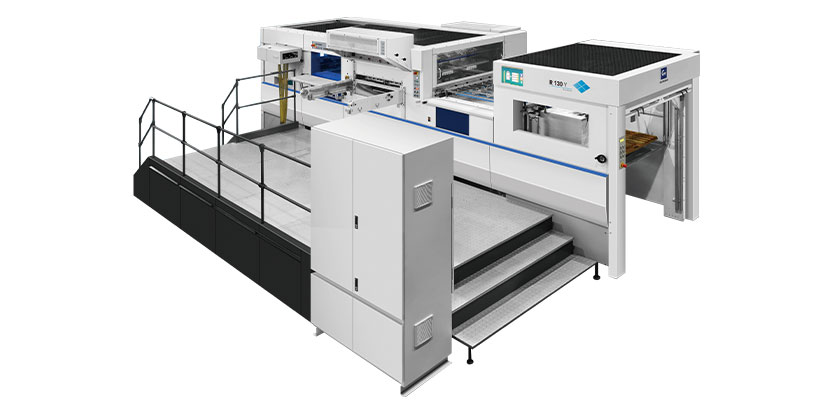
That drift is not inevitable. A foil stamping machine designed for hologram positioning and precision die‑cutting uses six independently controlled servo foil axles that maintain register across temperature changes. The GUOWANG integrated system also monitors foil consumption, stops the press before a roll runs out, and adjusts stamping pressure in 0.01mm increments through a touch screen. This guide explains how 20 heating zones, a 1600mm non‑stop feeder, and a single‑pass foil‑plus‑cut design eliminate the drift that ruins long‑run jobs.
Six independent servo foil axles – why one roll running low shouldn’t stop the other five
A luxury carton often requires multiple foil applications per sheet. A perfume box might have a gold brand mark, a holographic security seal, and a metallic decorative border. On a conventional press, each foil roll feeds from a common shaft or a fixed brake system. When one roll runs low, the tension on that roll changes, affecting the register of all the others.
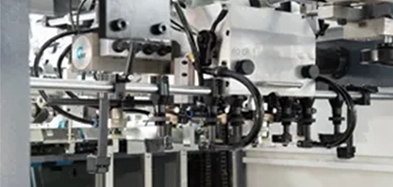
The GUOWANG platform installs up to six Yaskawa servo motors, each controlling an independent foil axle. Each motor pulls its own foil at a programmed length and acceleration curve. The system monitors remaining foil on each roll and triggers a foil‑remaining alarm individually. When a single roll reaches the set minimum, the press can stop after the current sheet or finish the stack—but the other five axles do not lose register.
On a job with six different foil stamps per sheet, that independent control means the operator changes one roll without recalibrating the entire job. The “last sheet missing hologram” failure becomes impossible.
How the servo system compensates for thermal growth
Foil feed rolls expand when the press runs for hours. A steel roll heating from 20°C to 40°C grows by several hundredths of a millimetre, changing the effective pull length per cycle. A conventional clutch‑brake system does not compensate. Each cycle, the register drifts a little more until the hologram is visibly out of position.
A servo drive with closed‑loop encoder feedback measures the actual rotation of each axle and adjusts the next pull to match the programmed length regardless of roll diameter or temperature. The press maintains ±0.075mm register over 50,000 sheets.
0.01mm pressure adjustment – the number that determines whether an embossed logo looks premium or looks like a dent
Embossing depth is not a binary “deep enough or not” setting. On a thin carton board, too little pressure leaves a faint impression that disappears when the carton is folded. Too much pressure cracks the paper fibre, creating a white stress line that printing cannot cover.
The GUOWANG automatic hot foil stamping and die‑cutting machine adjusts pressure via the touch screen in 0.01mm increments. That is a finer resolution than the thickness of a sheet of 80gsm paper. For a brand logo embossed on 400gsm board, 0.01mm precision means the operator can dial in exactly the depth that shows a crisp shadow line without cracking the reverse side.
Why drift in mechanical toggle presses costs you every shift
A mechanical toggle press uses a linkage that multiplies force at the end of the stroke. The linkage has wear points. After 1,000 operating hours, the pins develop play. The effective pressure at the platen changes by 0.05‑0.10mm without any change in the setting. Operators compensate by increasing the mechanical stop, which further accelerates wear.
A hydraulic or servo‑driven pressure system with a digital readout and real‑time monitoring holds the setpoint regardless of linkage wear. The GUOWANG system alerts the operator when pressure deviates by more than a programmed tolerance, and the press stops before out‑of‑spec sheets are produced.
Twenty heating zones – how a full‑sheet foil design goes from patchy to perfect
The centre of a steel platen heats faster than the corners. A 1000×700mm plate can have a 15°C difference from centre to edge at startup. A full‑bleed foil design that covers most of the sheet will transfer perfectly in the centre and fail at the edges if the press has only two or three heating zones.
The GUOWANG press divides the platen into 20 independently controlled temperature zones. Each zone has its own thermocouple and solid‑state relay. The 19‑inch HMI displays all 20 readings. The operator sets a temperature profile—cooler zones in the centre, warmer zones near the edges—to compensate for the platen’s thermal behaviour. Once set, the system maintains each zone within ±1°C.
| Press Feature | What It Does for a Long Run |
|---|---|
| 20 independently controlled heating zones | Uniform foil adhesion from edge to edge, no cold corners |
| 0.01mm pressure adjustment | Consistent emboss depth from sheet 1 to sheet 50,000 |
| Six independent servo foil axles | Individual roll monitoring; one roll finishing does not disturb others |
| Foil‑remaining alarm with auto‑stop | No incomplete stamps at the end of a roll |
| 1600mm pile height with non‑stop feeder | Reload paper without stopping the press |
One pass, not three – where the real productivity gain hides
A cosmetic carton job requires foil stamping (brand mark), embossing (texture), and die‑cutting (window and shape). On separate machines, that is three passes. Each pass adds handling, storage between processes, and the risk of register error. The foil stamp may be perfect, but if the die‑cut shifts 0.2mm, the entire carton is scrap.
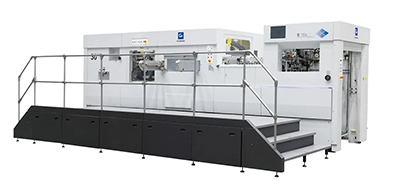
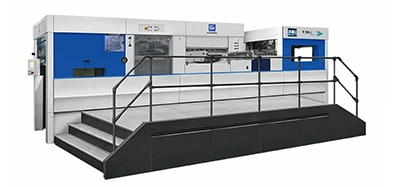
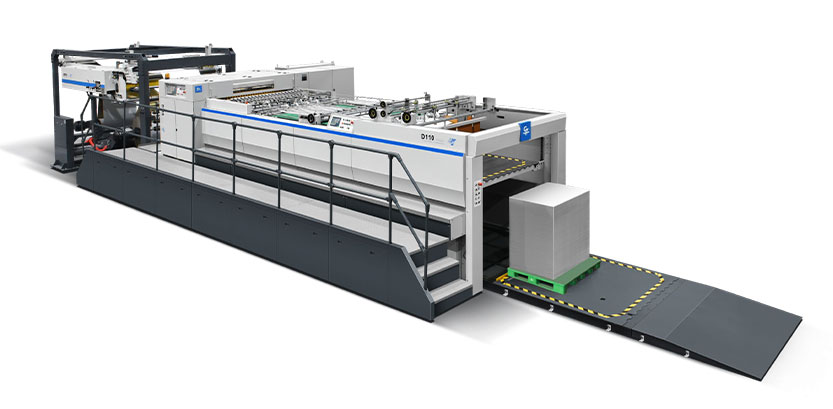
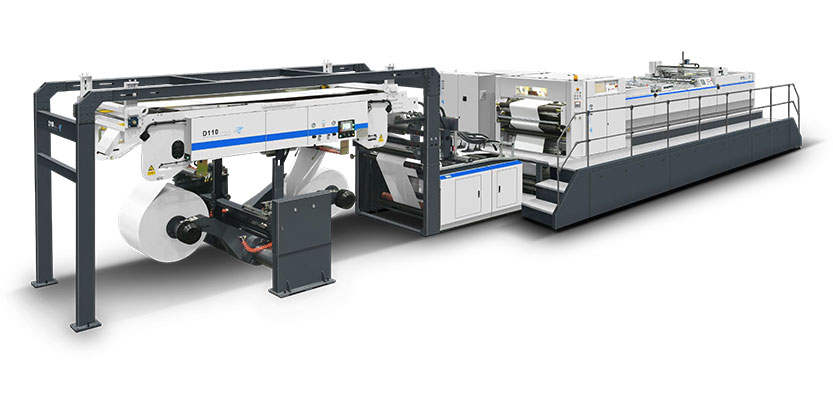
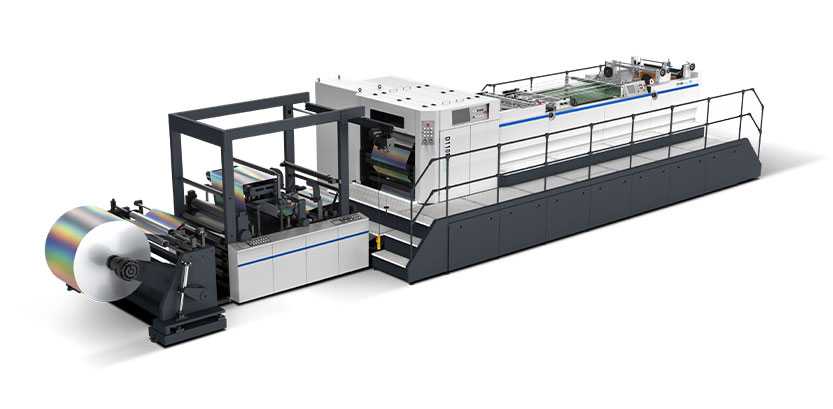
The GUOWANG integrated press performs all three operations in one pass. The sheet registers once to the gripper edge. The foil station stamps, the embossing station forms the texture, and the die‑cutting station cuts the shape. The register accuracy between stamping and die‑cutting is ±0.075mm (hologram stamping ±0.20mm). For a 100,000‑carton run, eliminating two passes cuts total production time by approximately 65% and removes the inter‑pass handling scratches and dust.
What the ±0.075mm register spec actually buys you
A folding carton with a die‑cut window and a foil border around that window will show any misalignment immediately. A 0.2mm offset makes the border appear unbalanced. A 0.5mm offset creates visible slivers of un‑foiled board. At 0.075mm, the naked eye cannot detect the misalignment. The carton looks premium, and the customer does not reject the shipment.
The 1600mm pile height that keeps a press running through lunch
A short feeder pile forces the operator to stop every 20‑30 minutes to reload paper. Each stop costs 60 seconds of lost production. Over an eight‑hour shift, that accumulates to 16‑24 minutes of downtime that is completely avoidable.
Maximum pile height on this press is 1600mm. At typical carton board thickness (0.4‑0.6mm), that is approximately 2,500‑3,500 sheets. At 5,000 sheets per hour, the pile runs for 30‑40 minutes before requiring a reload. More importantly, the press uses a rail‑guided preload device. The operator places the next stack on a waiting carriage while the press draws from the active pile. When the active pile empties, the carriage slides in without stopping the press. Reloading a stack adds zero seconds of downtime.
Why pile height affects feeding consistency, not just runtime
A tall pile puts weight on the bottom sheets. The friction between sheets changes as the pile height decreases. On a press without active pile‑pressure compensation, the top sheets feed differently from the bottom sheets, causing register drift across the run. The GUOWANG feeder uses adjustable air blast and separation plates that compensate for pile height changes automatically. The operator sets the air volume once, and the press maintains feed consistency from the first sheet to the last.
Three mistakes a production manager learned to stop making after switching to an integrated press
The first mistake was buying separate foil stamping and die‑cutting machines for the same sheet size. The foil stamper sat idle while the die‑cutter ran, and vice versa. Capital tied up in two machines, floor space taken by two footprints, and two sets of operator training. The integrated press replaced both with a single machine, one footprint, and one operator.
The second mistake was trusting the foil roll manufacturer’s length markings. A roll marked “200 metres” often delivers 195 metres plus a splice. The operator, thinking there was 10 metres left, walked away. The press ran out while stamping, producing 50 incomplete sheets before anyone noticed. The foil‑remaining alarm on the integrated press stops this by using actual pull measurement, not the manufacturer’s label.
The third mistake was ignoring the 20‑zone heating system during changeover. The operator set the entire platen to 120°C for a job that ran fine on a 3‑zone press. The centre overheated and the paper scorched. The fix—using the stored job profile that set centre zones cooler and edge zones warmer—turned a scrap pile into a successful run.
Where the automatic foil stamping and die‑cutting machine fits into a high‑volume packaging line
GUOWANG builds this integrated platform in a 160,000‑square‑metre facility holding more than 100 patents. The press uses Yaskawa servomotors for the six foil axles, Siemens PLC control, and SMC pneumatics. It carries ISO 9001 and CE certifications, with remote diagnostic support and on‑site engineering available through GUOWANG’s global network.
The machine produces cosmetic cartons, pharmaceutical folding boxes, greeting cards, wine labels, holographic security packaging, and confectionery boxes where foil and die‑cut must align perfectly on every single carton. Stored job profiles recall every parameter—20 zone temperatures, six foil pull lengths, pressure setting, and feeder air volume—making repeat orders as easy as selecting a name on a screen.
For a foil stamping machine that eliminates the drift, the missing‑foil surprises, and the extra passes, the GUOWANG integrated system delivers 0.075mm register between stamping and die‑cut, automated foil‑remaining alarms, and a non‑stop feeder that keeps the press running through the shift.
【Request a quote from GUOWANG】
Contact GUOWANG with your maximum sheet size, yearly foil stamping volume, and whether you run holograms or standard foil for a machine recommendation.
 English
 Français
 Español
 Português
 عربي
عربي